← Digital Onigiri

From the creator · Week of Mar 16–22, 2026

The Terminal IS the IDE Now

YEN has a Terminal-first IDE stack with local LSP workflows, encrypted sharing, devcontainer control, deterministic VS Code import, review tooling, and more.

Technical updates

No build shipped this week

No build shipped this week. The notes below are about the work in progress.

Written by hand

Notes from the creator

The Terminal IS the IDE Now

YEN has a Terminal-first IDE stack with local LSP workflows, encrypted sharing, devcontainer control, deterministic VS Code import, review tooling, and more.

Hey folks!

There is a pattern I have been watching for years.

Most developer tools say they love the terminal, then quietly treat it like a basement utility room. And it always kind of feels like it lives in the basement at the bottom of the screen, right?
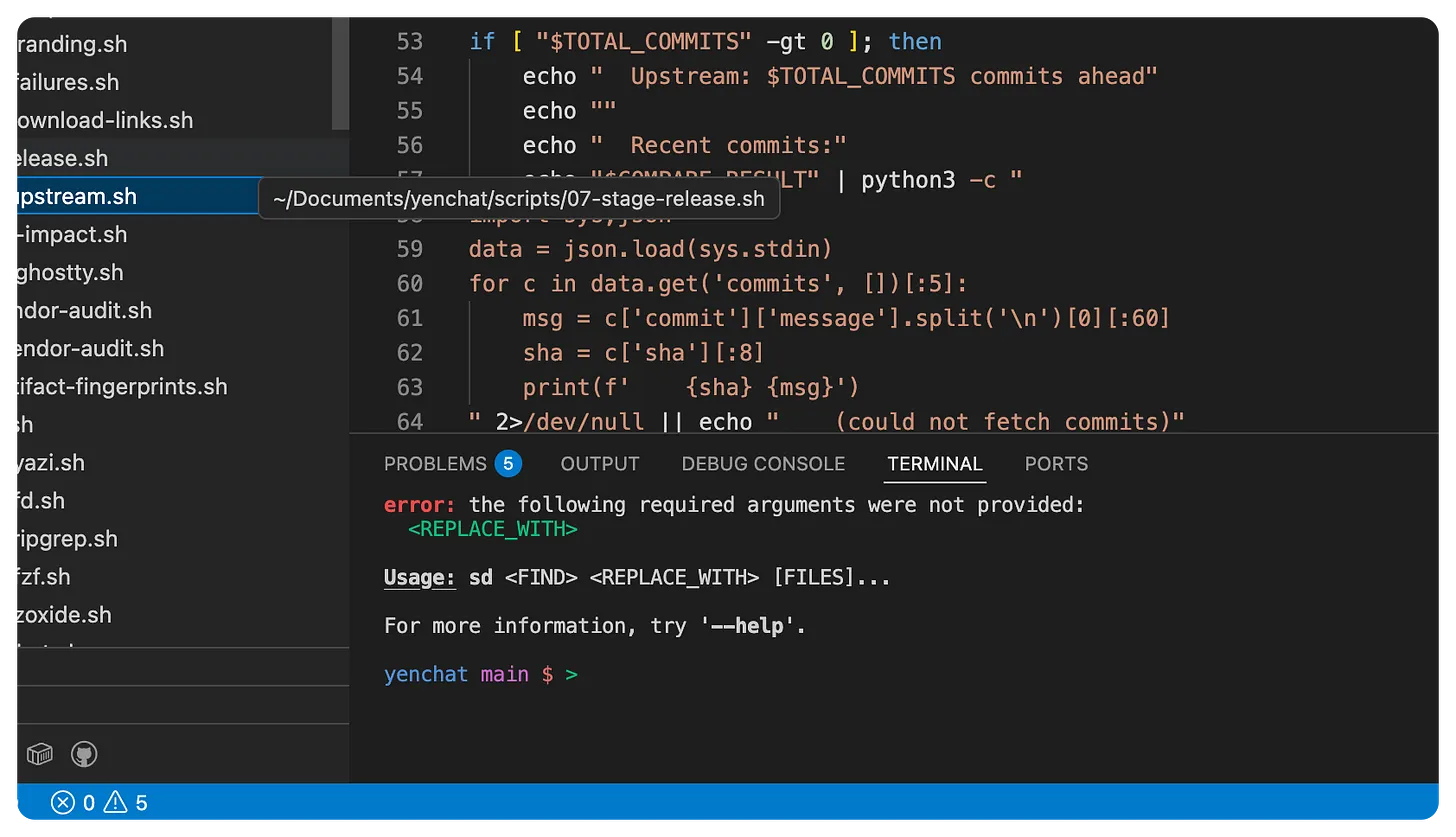
The editor gets the architecture. The terminal gets a small panel.

Boohiss.

The editor gets the first-class search, the code intelligence, the review flows, the collaboration story, the automation surface, and the gentle product language about focus and speed. The terminal gets a rectangle at the bottom and maybe a button that says “open integrated terminal.”

I never thought that that was good enough, at least from my perspective!

The terminal is not a sidecar for serious engineering work. It is the place where code actually meets reality. It is where builds fail, migrations go sideways, diagnostics become actionable, PRs get reviewed, services get restarted, environment mistakes surface, and dangerous commands should feel dangerous before you press Enter.

That is why I have been pushing YEN toward a different thesis: Do not bolt a terminal onto an IDE. Build the IDE around the terminal.

And the most recent release — v0.999 — is the biggest step so far in that direction as YEN now ships a real terminal-first IDE surface.

Not a concept page.

Not a chat sidebar pretending to be an IDE.

Not a cloud account plus a terminal skin. Eww.

Nope. None of those things. Instead, we have a real, local-first workflow stack that starts in the terminal and stays there unless a richer native macOS surface is actually justified. Here are the 8 major pieces that bring it all together.


1. Project Awareness

The first big piece is project awareness.

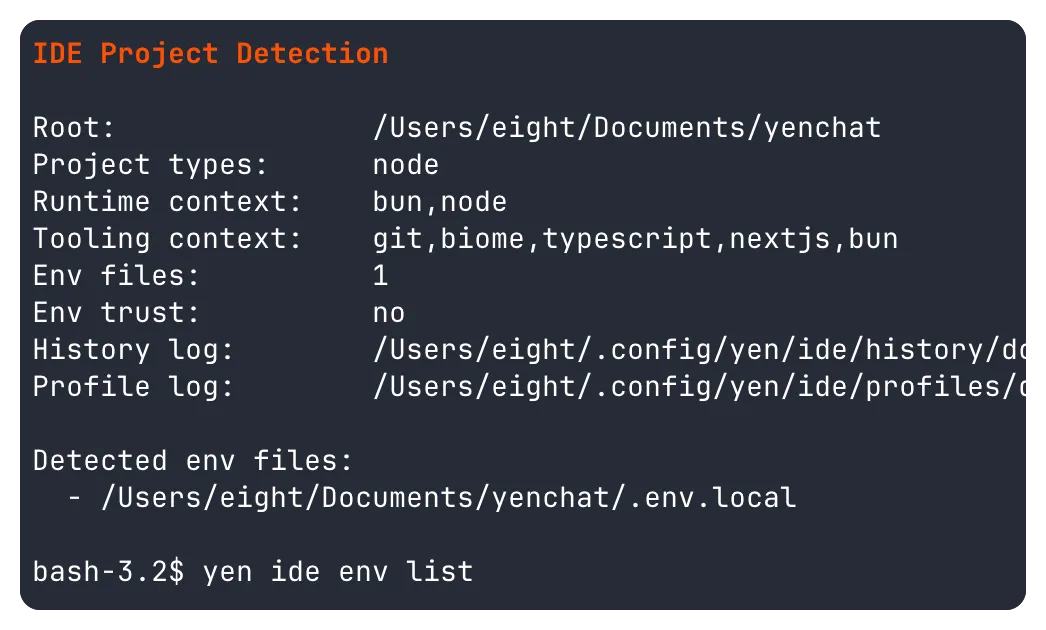
YEN now understands enough about the current repository to make terminal workflows feel contextual instead of generic. yen ide detect finds the project root and runtime / tooling context. yen ide env gives you explicit trust-gated environment loading. yen ide history, replay, and profile turn the terminal into something closer to a project memory instead of a disposable scrollback trench.

That matters because terminal-first tooling only works if the terminal knows where it is, all the time, even when you forget.

2. Search with First-Class Objects

The second big piece is search that treats engineering artifacts like first-class objects.

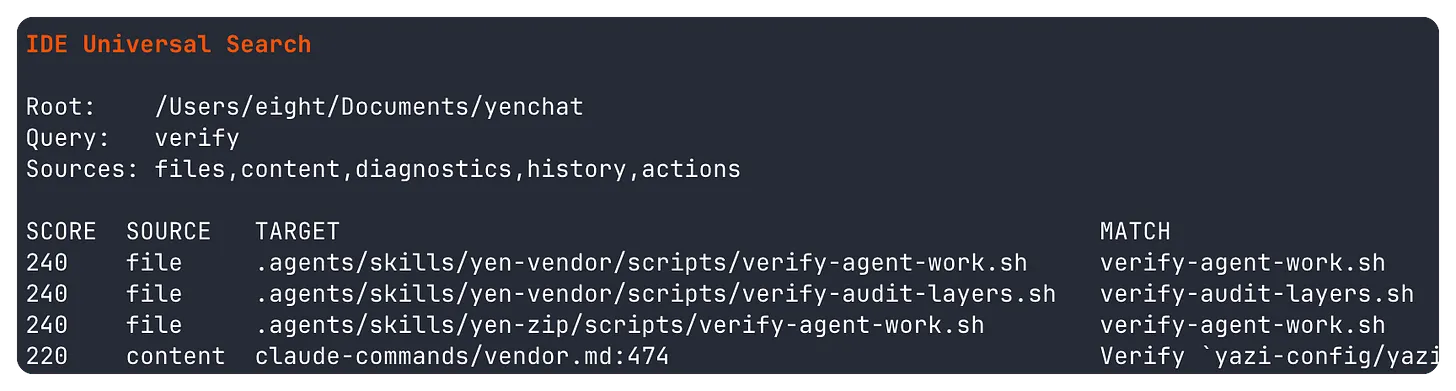
yen ide search can rank across files, content, diagnostics, project history, and actions. On macOS, the same contract now powers the desktop command palette. Empty query launches actions.

A typed query searches built-in actions first, then falls back to project files, content, diagnostics, and recent history for trusted local repos. That means the search surface you invoke with Cmd + Shift + P is no longer just a launcher.

It is a project-aware terminal IDE entry point.


3. Local Code Intelligence

The third big piece is local code intelligence.

YEN now ships an explicit LSP control plane with yen ide lsp trust, start, status, diagnostics, hover, definition, references, rename, stop, and a bounded install matrix. Cool.

This all includes real resolver-backed supervision when a local language server exists, placeholder guidance when it does not, grouped diagnostics snapshots with freshness labeling, and interactive request surfaces that stay honest about whether they are using live LSP or syntax-aware fallback.

That last part matters to me a lot. I do not want “smart” terminal tooling that lies.

If YEN is using a live language server, it says so. If it is using AST fallback, it says Source: ast. If the language is unsupported or the expected local server is missing, it says that too.

Honesty is a feature. Who would have thought.


4. Syntax-Aware AST Queries

The fallback layer is the fourth piece: Syntax-aware AST queries.

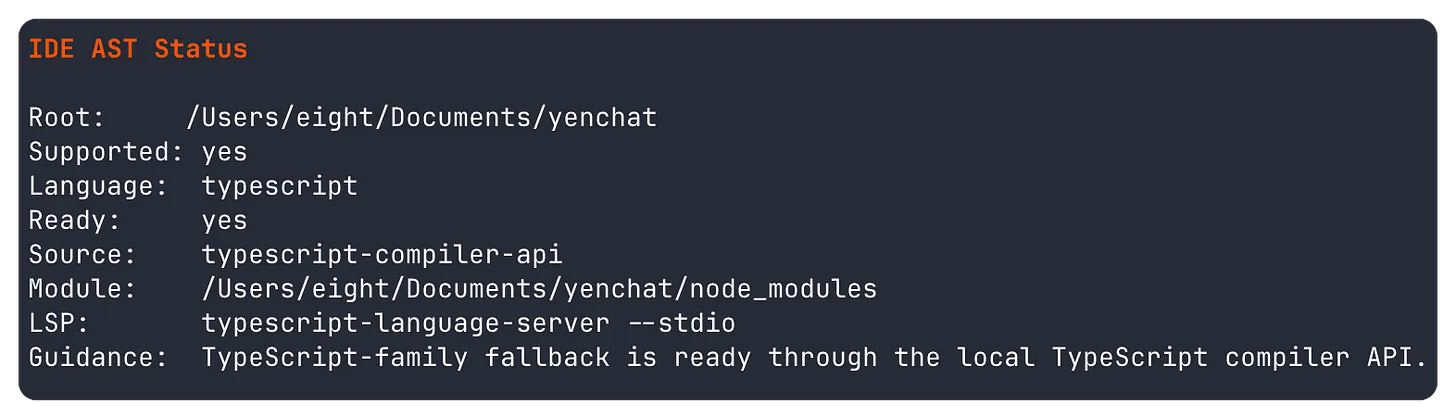
When live LSP is not available, YEN can still answer useful structural questions with yen ide ast status, definition, and references for the currently shipped languages.

That means the terminal does not have to collapse all the way down to dumb text search every time a full server is absent.

5. Execution Discipline

The fifth piece is execution discipline.

This is where terminal-first IDEs have a chance to be better than editor-first ones. Or that’s the hope!

YEN now ships yen ide explain for failed command analysis, yen ide verify for multi-language verification bundles, yen ide gate for risk-aware approval checkpoints on dangerous commands, yen ide workflow for schema-validated project workflows, yen ide timeline for local audit events, and yen agents for first-party adapter coordination. Wild.

There is also yen ide pr-notify for GitHub review-request polling and yen ide pr-review for focused diff review, evidence bundles, inline comments, and explicit review decisions.

This is not about adding ceremony.

It is about making the terminal better at the parts of engineering work where context, the ability to easily review work, and general safety actually matter.


6. Collaboration without Bloat

The sixth piece is collaboration without a custom relay empire.

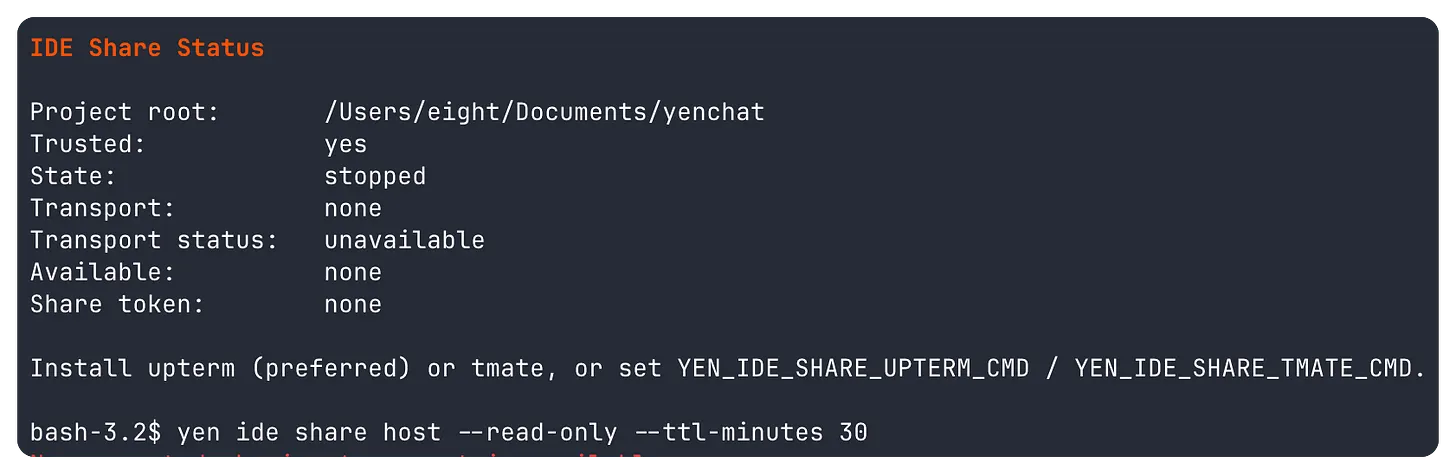
YEN now ships yen ide share status, host, join, revoke, trust, and untrust using an integration-first transport model: upterm first, tmate as fallback. Share tokens are encrypted locally. Hosting is per-project and explicitly trusted. Join flows validate the token locally before any transport command runs. Sessions can be read-only or interactive. TTL expiry and immediate revoke are part of the contract.

This was an important design choice.

I did not want to build a bespoke terminal-sharing service just to say YEN has collaboration, which would be fun but not entirely useful.

You see, there are good maintained tools for this job already. The right move was to build the control plane, trust model, audit trail, and operator ergonomics around them instead of pretending every feature needs a net-new backend.


7. Environment Parity and Migration

The seventh piece is environment parity and migration.

YEN now ships yen ide devcontainer status, up, shell, and down as a trust-gated wrapper around the reference devcontainer CLI. It is intentionally local-workspace scoped. No hidden runtime. No bundled container stack.

No pretending YEN needs to become Docker Desktop.

YEN also ships yen ide vscode inventory and import so teams can inspect existing VS Code workspace config, classify what is supported or partial, and write deterministic YEN-local migration artifacts without mutating the original workspace by surprise. Dry runs emit real diffs. Applied writes are convergent. That is the kind of migration behavior I want from tooling: boring, inspectable, and reversible.

8. Native macOS IDE Surfaces That Actually Help

The eighth piece is native macOS IDE surfaces where they actually help.

This is the part that makes YEN feel different.

The command palette now exposes quick IDE actions like IDE: LSP Status, IDE: LSP Diagnostics, IDE: LSP Install Matrix, IDE: Share Status, IDE: Share Host (Read-Only), IDE: Share Revoke, IDE: Devcontainer Status, IDE: VS Code Inventory, IDE: VS Code Import (Dry Run), and IDE: AST Status.

On top of that, macOS now has a dedicated desktop PR review workspace and a dedicated desktop merge-conflict workspace launched from the same palette. Those are native surfaces, not browser panes, and they stay anchored to the active repository context instead of trying to replace the terminal.

That is the pattern I want YEN to keep following.

If a task is fundamentally terminal-native, keep it in the terminal.

If a task genuinely benefits from a richer surface, build a native one and keep it close to the terminal instead of escaping into a second application model.

That is a better division of labor than the one most IDEs settled on.


Bonus: Local First

There is also a security and trust story here that I think matters more than the marketing layer most developer tools put on top.

This IDE stack is local-first. Project trust is explicit. The LSP runtime is per project. Sharing trust is per project. Diagnostics snapshots are local.

Devcontainer orchestration shells out to the reference CLI you already chose to install. VS Code import writes project-local artifacts instead of disappearing into a hidden sync service.

None of that is as flashy as saying “agentic workspace intelligence” in a launch trailer, but I think it is the right way to build tools engineers can actually trust.

And there is still plenty left to do!

Debugger work remains future work. Remote devcontainer parity is still a deliberate follow-up instead of a hand-wavy promise. Agent-runtime hardening and context reliability still have room to grow. I am not pretending YEN is finished.

But the shape is real now. You can feel the product thesis in your hands.

The command palette is not just a launcher anymore. The terminal is not just an output window anymore. The IDE is not somewhere else anymore.

It is here.

If you want a feel for the surface area, this is a compact starting path:

bash
yen ide detect
yen ide env list
yen ide lsp status --format json
yen ide lsp diagnostics
yen ide lsp hover src/app.ts:12:3
yen ide share status
yen ide share host --read-only --ttl-minutes 30
yen ide devcontainer status
yen ide vscode inventory
yen ide search verify
yen ide verify --quick
yen ide pr-review 123 --loop
yen ide timeline --limit 20

And if you are on macOS, press Cmd + Shift + P and start from there.

That shortcut has quietly become one of the best ways to feel the whole philosophy of YEN in a few seconds.

Open the palette. Launch a real IDE action. Search a repo. Review a PR.

Inspect diagnostics. Start a share session. Import a VS Code workspace in dry-run mode. Then close the palette and notice that you never left the terminal-first workflow to do it.

That is the point.

The goal is not to cosplay as a giant editor suite. The goal is to make the terminal powerful enough, contextual enough, and trustworthy enough that you stop needing to flee from it for everyday engineering work.

That is the release. That is the mission.

And for the first time, I think it is fair to say it plainly:

The terminal is the IDE now. About damn time.

— 8
Making the Terminal-First IDE Even Stronger

Semantic locations, stronger review flows, clearer trust and health reporting, repo-native execution, honest polyglot intelligence, and more.

Update for YEN 1.285. delta is no longer bundled. yengit review and yen ide pr-review print plain diffs, and the merge-conflict preview colors the patch itself.

Hey folks!

Last week I published an important post about how the Terminal is the IDE now and I’ve been working on making it even better.

The Terminal IS the IDE Now

Hey folks!

You see, that first post was the thesis. The terminal should not be a utility room bolted onto the bottom of an editor. It should be the place where engineering work actually stays coherent. It just makes sense.

This follow-up is about something slightly less glamorous and much more important: Making that IDE layer behave like one system instead of a pile of unrelated features.

Because that is the real test.

Anybody can ship a burst of commands and a few native windows and call it an IDE story. The harder part is preserving context across those surfaces, making trust legible, staying honest about what is actually answering a query, and meeting repos where they already are instead of inventing a second configuration universe.

So that is what the most recent hardening pass was really about. Here’s what’s up and the details of what I’ve added.


1. Make the Output Survive the Workflow

The biggest change was not one flashy feature. It was a contract.

I wanted YEN to stop flattening useful engineering output back into vague text the moment it crossed a surface boundary. If a result points at a real file and line, that location should survive through the terminal, the command palette, the review flow, and the native macOS windows.

So the system now leans much harder on one shared semantic location model: path:line[:col].

That shows up in yen ide parse --format tsv, in verify reports, in workflow reports, in the command palette search path, in yen ide pr-review, and in the merge-conflict workspace. Content hits, diagnostics, review evidence, workflow output, and conflict selections can all point back to the same kind of target instead of degrading into “open this file and good luck.”

That sounds small until you use it.

Once the location contract stays intact, the command palette stops feeling like a launcher with some extra sugar on top. It starts feeling like a terminal-first IDE control plane. A search result can still be a real action. A review hunk can still be a real place. A test failure can still be a real jump target.

That is the difference between “there is a lot here” and “this actually holds together.”


2. Upgrading Git Review without Becoming Git

I also spent a lot of time strengthening the review baseline.

That did not mean building a separate Git universe inside YEN. I still think that would be the wrong move. The CLI should stay the source of truth. But the review path needed to get more capable and less lossy.

So the current baseline is now bundled lazygit plus bundled delta as the shared diff renderer. On top of that, yen ide pr-review picked up deterministic hunk inventory and semantic hunk targets, while the macOS PR review workspace and merge-conflict workspace both learned how to stay anchored to those same repo targets.

That has a few nice and positive effects.

Focused hunk previews are better. Plain-text fallback is explicit instead of pretending it is the same thing. Selected files and hunks can keep their target identity all the way through a review flow. The PR evidence path can carry the latest verify readiness and security snapshot with it. And the merge-conflict workspace can show a delta-backed patch preview, keep the selected hunk as a real location, and hand that target off to the editor before staging.

That is exactly the division of labor I want. Keep the terminal-native review flow in the terminal. Use a richer native surface when it genuinely helps and don’t try to pretend that the native surface is replacing the terminal.

Makes sense, right?


3. Trust, Doctor, and Verify Finally Read Like One Story

Another major improvement is that repo state is much easier to inspect before something goes wrong.

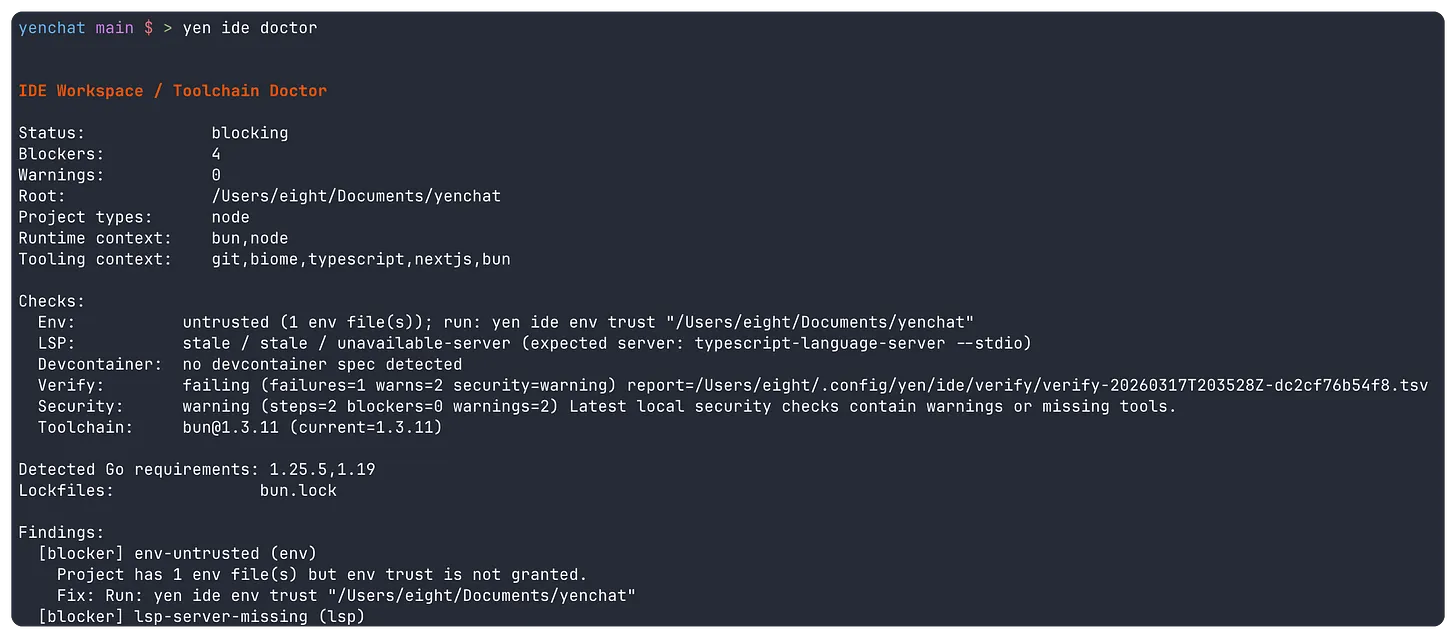
YEN already had a lot of the raw ingredients: Project trust, env trust, LSP trust, share trust, workflow trust, local verify artifacts, devcontainer state, language-server status, and so on. The problem was not missing data. The problem was legibility.

That is why yen ide doctor matters.

It takes the existing sources of truth and turns them into one repo-health snapshot with project context, toolchain and version signals, trust and runtime summaries, verify readiness, security state, and clear blocker versus warning findings. By default it exits non-zero when blockers exist, and --strict can intentionally make warnings fail automation too. It is deliberately direct. A health command that only tells you that it successfully collected state is not useful.

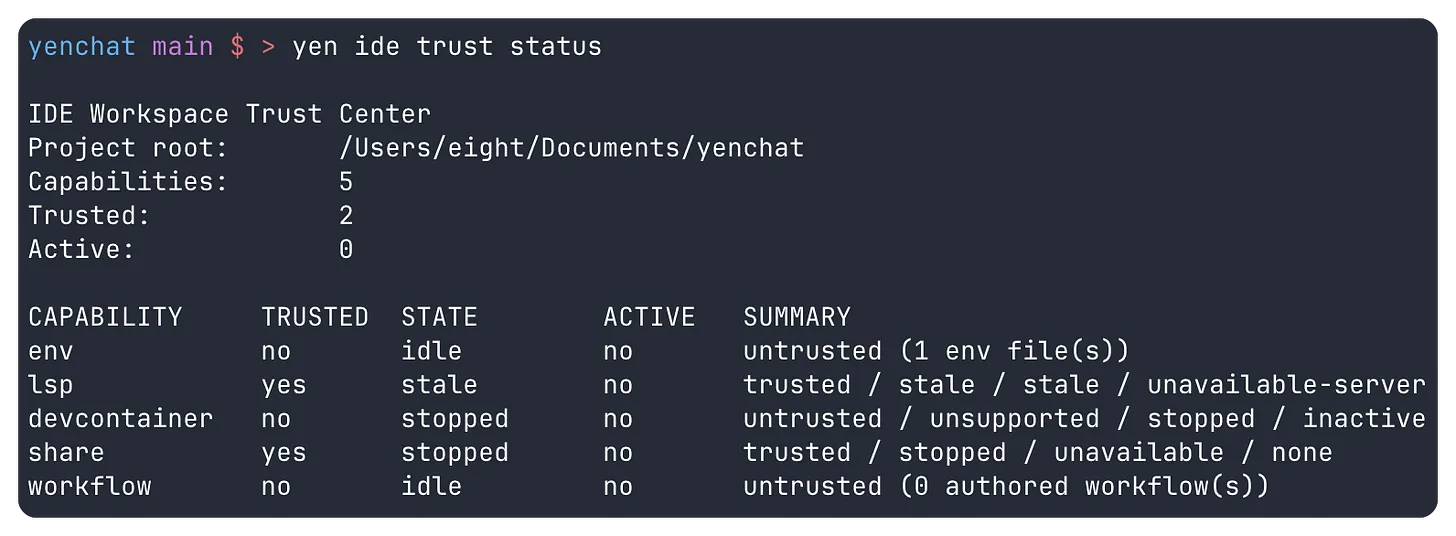
The same principle drove the workspace trust center. yen ide trust status gives one aggregate view over the trust and runtime or session state YEN already had. yen ide trust revoke and yen ide trust reset delegate back to the owning commands instead of mutating trust state behind their backs. That keeps the control plane honest.

And then there is the verify path.

yen ide verify status is now a read-only snapshot over the latest local verify artifacts, while yen ide verify carries explicit local osv-scanner coverage. More importantly, that readiness and security state is no longer trapped inside one command. It can surface in doctor and in PR evidence previews too.

That matters because security is not a separate product. It is part of whether a repo looks ready to act on right now.


4. Meet Repos Where They Already Are

This is one of the places I care most about not getting cute.

A lot of developer tools become less trustworthy the moment they stop respecting the repo in front of them. They invent a second workflow system, a second task runner, or a second configuration universe and then ask you to keep both in your head forever.

I do not want that.

So a lot of the recent work was about making YEN better at reading the repo’s existing signals and putting them on one control plane.

yen ide workflow discover now inventories package scripts, Make targets, Just recipes, and Taskfile tasks with provenance, category, risk, and conflict visibility. yen ide workflow run --native is the explicit path for running one of those discovered tasks without pretending it is an authored YEN workflow, and it reuses the same trust, approval, timeline, and reporting plumbing as the rest of the workflow surface.

The quality surface follows the same rule. yen ide format, yen ide lint, and yen ide fix prefer repo-native tasks first, fall back narrowly when the repo already implies a toolchain, reuse the existing trust and approval model, and write dedicated quality reports instead of disappearing their behavior into a black box.

The test surface does too. yen ide test status and yen ide test run build on the same repo-native runner detection and verify artifacts instead of inventing a second language matrix just for testing. Grouped failures, rerun-failed behavior, and semantic jump targets all sit on that same baseline.

And the VS Code migration path got more serious in the same spirit. yen ide vscode inventory and yen ide vscode import now produce richer extension guidance, task and test parity notes, and deterministic local artifacts like migration-report.json and manual-cleanup.txt under .yen/vscode-import.

The common theme is simple: I want YEN to reduce ambiguity, not replace the repo with a parallel religion.


5. Honest Polyglot Intelligence > Pretend Coverage

The code-intelligence layer also got sharper, and I am happy about this one because it pushed the product further in a direction I care about a lot: Honesty.

In the first post about a Terminal-first IDE I said I do not want “smart” terminal tooling that lies. That rule matters even more once multiple languages and multiple fallback modes are involved.

So the install and fallback story is much more explicit now.

JavaScript and TypeScript share one managed baseline. Python and Go have their own managed paths. Rust points at rustup. Swift points at the Xcode or Swift toolchain. Zig expects zls on PATH. YEN does not silently blur those operational models together.

The AST side got stronger too. yen ide ast status, definition, and references now have real parser-backed fallback for Python, JavaScript and TypeScript, Go, and Swift, and the output says what is actually answering the query: python-ast, typescript-compiler-api, go-parser, or swiftc-dump-ast-json. Those results stay clearly labeled Source: ast so fallback never masquerades as live LSP.

Unsupported languages stay explicit instead of getting vague marketing support. Bun-backed JavaScript projects also stop falling off the AST path just because the runtime detection looked slightly different from the normalized JS family.

That is the kind of improvement I want from this layer.

Not bigger claims. Clearer contracts.


6. The Boring Internal Work Is Product Work Too

There was one other slice in this pass that matters even though it is much less visible from the outside: the IDE CLI modularization work.

I do not want every future IDE feature to keep piling into one giant Bash entrypoint until the safest answer becomes “please do not touch this file.” That is how products slow down. That is how regressions get stickier. That is how shipping momentum dies.

So the router and bootstrap layer stays stable in yen-cli/commands/core/ide, while the shared helpers and capability families live in sourced modules behind explicit loader-contract checks.

The user-facing CLI did not change. The implementation risk did.

If you want to feel the current shape of the terminal-first IDE layer, this is a pretty good compact path:

bash
yen ide doctor
yen ide trust status
yen ide lsp status
yen ide ast status
yen ide workflow discover
yen ide workflow run --native package:test --dry-run
yen ide format status
yen ide test status
yen ide verify status
yen ide pr-review 123 --list-hunks

And if you are on macOS, press Cmd + Shift + P after that.

Search the repo. Open a review surface. Inspect diagnostics. Jump to a hunk. Pull up trust state. Notice how often the system can keep the location, the context, and the repo identity intact instead of making you reconstruct it by hand.

That is what this follow-up post is really about. The first post in the series was about saying the terminal is the IDE now.

This one is about making that sentence even more true.

There is still more to do. Editor handoff parity, remote parity, merge-readiness reporting, and benchmark work are all still on the table.

But the IDE layer is already better now in the ways that matter most to me: More coherent, more inspectable, more honest, and more native to the repo that is actually in front of you.

I like where we’re going together.

— 8

More issues

Newer · YEN v1.000 is Here ↗Older · Hardening Speech-to-Text in Your Terminal ↗All release notes ↗All issues ↗