


Hey folks!
The first IDE post was about ambition. The second one was about cohesion. This one is about proof (or the burden of proof). Because if you can’t trust your Terminal and IDE to do what you want, then, what’s the point?
It has to work. Or it doesn’t.
You see, a Terminal-first IDE cannot stop at having a lot of commands, and it cannot stop at having those commands point at each other in mostly sensible ways. At some point the product has to answer the question that matters more than all of that: When it tells me something about my repo, should I believe it?
That is the standard that anyone should hold any Terminal to and it’s the standard that I hold to the work that I do for this tool and our growing community of users.
I do not want an IDE that performs confidence; I want one that can defend its claims. I want it to be explicit about what it knows, what it does not know, which local facts produced the answer, where the boundary of authority ends, and what has to stay a human judgment call.
If the terminal is going to remain the center of gravity, it needs to feel less like a loose toolkit and more like a system with a memory, a vocabulary, and a conscience.
That is what this phase of YEN has been about and what is necessary before I feel comfortable giving this project a real v1.000 stamp.
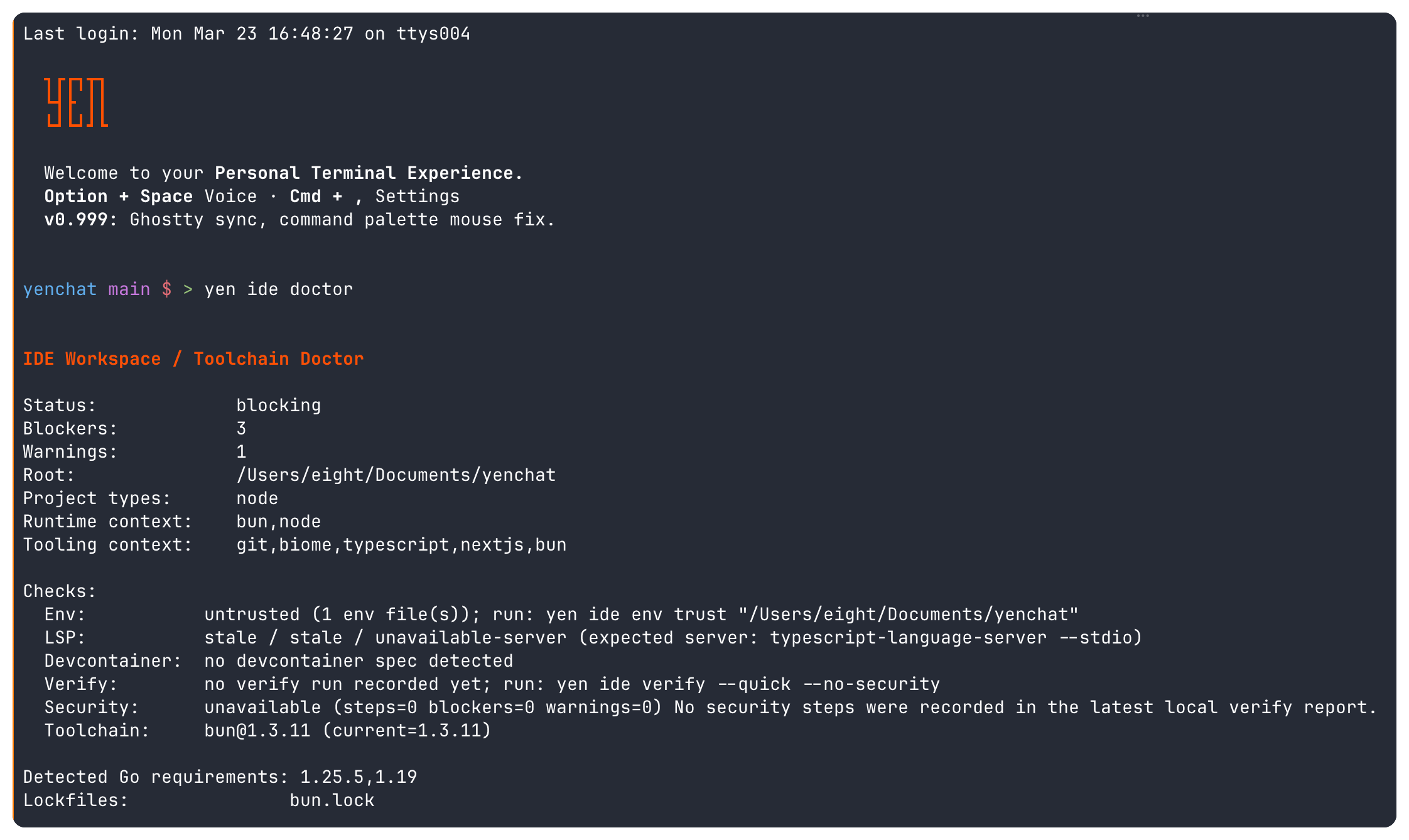
Readiness Has to Reuse the Evidence Model
The clearest example is yen ide merge-readiness.
Before a branch is ready, I usually already have the evidence somewhere. The repo has a working tree state.
yen ide doctor knows whether the workspace is healthy.
yen ide trust status knows whether the repo has been explicitly trusted.
yen ide verify status knows whether readiness and security gates have actually run.
Git knows how large the diff is and which files look risky. The local timeline already knows what the recent gates and review surfaces have done. Sometimes GitHub metadata is available too.
The problem was never missing evidence. The problem was fragmentation.
Once a repo gets large enough, the cost of answering a simple question like “is this safe to review?” is no longer the cost of one command. It is the cost of rebuilding the same mental model from half a dozen surfaces every single time. That is exactly the kind of work I think an IDE should eliminate.
What I did not want was the obvious fake solution.
I did not want a separate readiness database. I did not want a second approval workflow. I did not want a new trust vocabulary that would immediately start drifting from doctor, verify, review, and timeline. That is how tools become bureaucratic. They solve a visibility problem by creating a state problem.
So merge-readiness is not another authority surface. It is an aggregation surface over the evidence model that already exists.
It reads the current doctor state, trust summary, verify readiness and security snapshots, git diff heuristics, risky-file context, local gate and review history, and optional current-branch PR metadata when that exists. Then it gives me one recommendation: safe to review, safe to merge, or needs human check.
The label matters less than the defense behind it. If checks are missing, it says so. If security is blocked, it says so. If review state is still draft or changes-requested, it says so. If the repo has no baseline evidence at all, it does not pretend a green answer exists. It stays conservative and tells me exactly which facts are making it uncomfortable.
That is the point. I do not think users want a prettier green badge. I think they want a tool that can justify the badge.
The Cost Model Has to Stay Honest Too
Trust is not only about correctness. It is also about cost.
An IDE can have a convincing readiness story and still betray the user if every new layer quietly makes the terminal slower, heavier, and harder to reason about. I did not want to argue that the terminal can be the IDE while hand-waving away the performance bill.
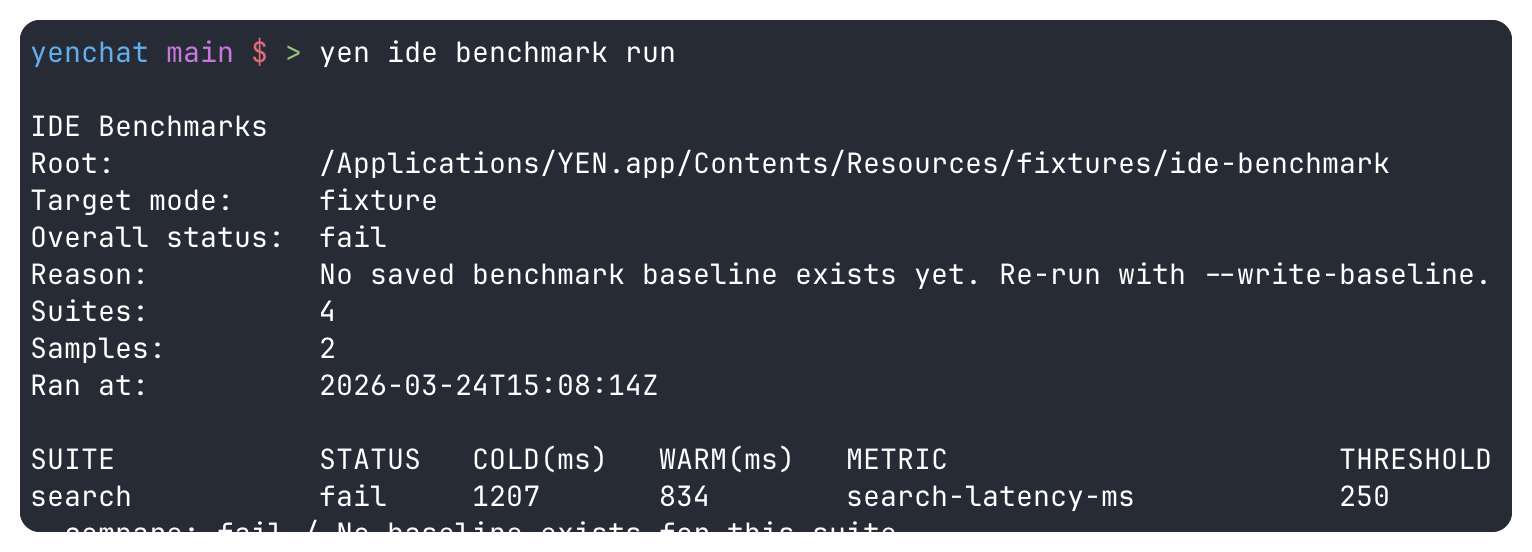
That is why I shipped yen ide benchmark status and yen ide benchmark run.
I wanted proof checked into the product instead of folklore. The benchmark harness runs deterministic suites for search latency, LSP startup latency, verify duration, and orchestration control-plane overhead. It records cold and warm timings, captures an environment stamp, writes a latest report, compares against a saved baseline, and fails closed when the proof is missing or when a regression is large enough that I should treat it as real.
That fail-closed behavior matters. I did not want a benchmark surface that always sounds informative but never has consequences. If YEN is going to claim trust, its performance evidence has to be usable as a gate, not just as dashboard decoration.
I also wanted the performance story to reuse the same discipline as the readiness story. So the benchmark harness does not invent a separate telemetry universe. Its suite latencies are mirrored into the same non-interference SLO ledger that already exists. Search, LSP startup, verify, and orchestration become explicit entries in one guardrail story instead of becoming a second performance control plane.
The fixtures matter just as much as the ledger. I did not want these numbers to depend on whichever repo happened to be under my cursor or whichever binaries happened to be installed that morning.
So the default path uses shipped fixtures under yen-cli/fixtures/ide-benchmark. Search and LSP run against a known TypeScript-shaped fixture. Verify runs against a deterministic local package-script fixture. Orchestration runs against mock adapters on a fixture-provided PATH. That gives me repeatable proof instead of a moving target.
The terminal-first bet gets stronger when the cost model is explicit. It gets weaker when the cost disappears into vibes.
A Semantic Target Has to Survive the Handoff
There is another way to lose trust that is easier to miss.
The product can have an honest evidence model and an honest cost model, and still feel unreliable if the moment I try to act on that evidence the target gets lost between surfaces. A diagnostic that cannot land in the right file is not much better than a guess. A review hunk that jumps to the wrong place erodes confidence far faster than a missing feature ever will.
That is why I shipped yen ide open, moved yen-yazi-edit onto the same launcher contract, and then pushed that same contract into the native macOS review surfaces.
The rule is simple: Every semantic target stays path:line[:col] all the way through.
Search results, diagnostics, verify output, PR review hunks, merge-conflict selections, and file-browser edit targets should not each invent their own editor-jump syntax. They should all reduce to one location contract, then let one planner decide how that target becomes a real editor launch.
That planner now resolves repo-relative paths, preserves quoted VISUAL and EDITOR argv, understands the editor-family goto matrix, and exposes an explicit dry-run plan so I can test the launch behavior before it surprises a user.
Code-family editors use --goto. Zed takes the direct target shape. Xcode goes through xed --line. Terminal editors keep their real line-aware capabilities where they exist. Plain editors fall back to opening the resolved file only, with the loss of line-awareness made explicit instead of being silently swallowed.
The important part is not the matrix. The important part is the failure behavior.
This handoff now fails closed when the target no longer exists. It fails closed when the launcher is unavailable. If nvr is configured but there is no running server, it falls back to nvim instead of pretending a dead attach command counts as parity. Yazi uses the same planner. And on macOS, the native PR review and merge-conflict workspaces now go through the bundled yen ide open bridge for recognized GUI editors instead of maintaining a second Swift-only launch matrix with its own drift risks.
The same rule now applies to live LSP mutation. yen ide lsp code-actions takes that same semantic target, forwards matching diagnostics context when the server can actually use it, previews every returned action, and only auto-applies when there is one pure workspace edit to defend.
If the server returns multiple edit choices, a command-only action, an edit-plus-command action, or a disabled action, YEN stays in preview mode and says why. That is less magical than a universal quick-fix button. It is also much easier to trust.
That sounds like glue code. I think it is part of the trust model.
The reason is simple: if the product tells me where to look, it has to prove it can actually take me there.
Debugging Has to Leave Evidence
A debugger is where integrated tools often fall back into folklore.
A failing test might know the file. A review surface might know the risky hunk. A diagnostic might know the exact line. But the moment I want to cross from evidence into execution, a lot of products suddenly expect me to carry all of that context by hand, rebuild a launch command from memory, and trust that whatever happened in the debugger can somehow be rediscovered later.
I did not want that split either.
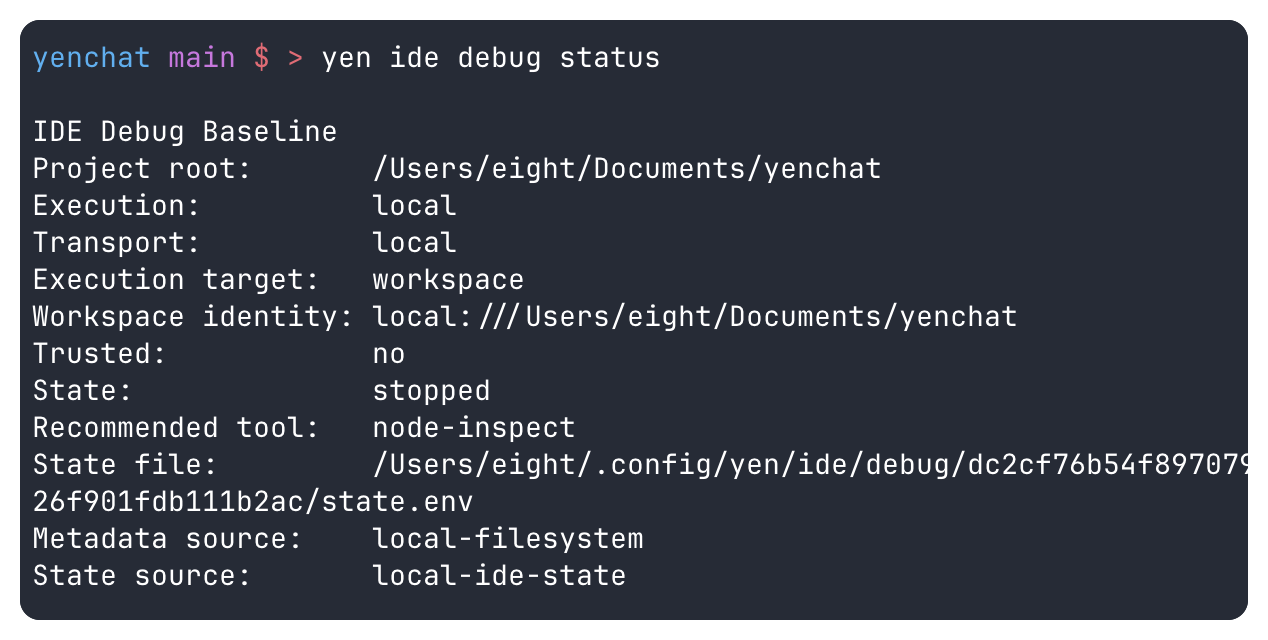
So the debugger work stayed on the same semantic target contract and the same trust model as everything else. yen ide debug status and yen ide debug start use the same path:line[:col] vocabulary as search, diagnostics, review, and handoff.
The shipped baseline is intentionally narrow: python-pdb, node-inspect, and lldb for the local, SSH-backed, and tracked-devcontainer cases I can actually defend. The product stays explicit about what is still blocked: attach-to-pid flows, TypeScript direct-file launch, package-debug flows, and any zero-config adapter install story beyond that shipped baseline.
The more important part is what happens after launch. Real debug runs now write summary, log, and transcript evidence into the same per-workspace state model. yen ide debug status can show me the last run. yen ide trust status can point back to the same artifacts. Timeline events carry the report paths forward. Managed local, SSH-backed, and tracked-devcontainer sessions all stay on that one surface. The debugger is not a private side quest anymore. It leaves a paper trail the rest of the IDE can reuse.
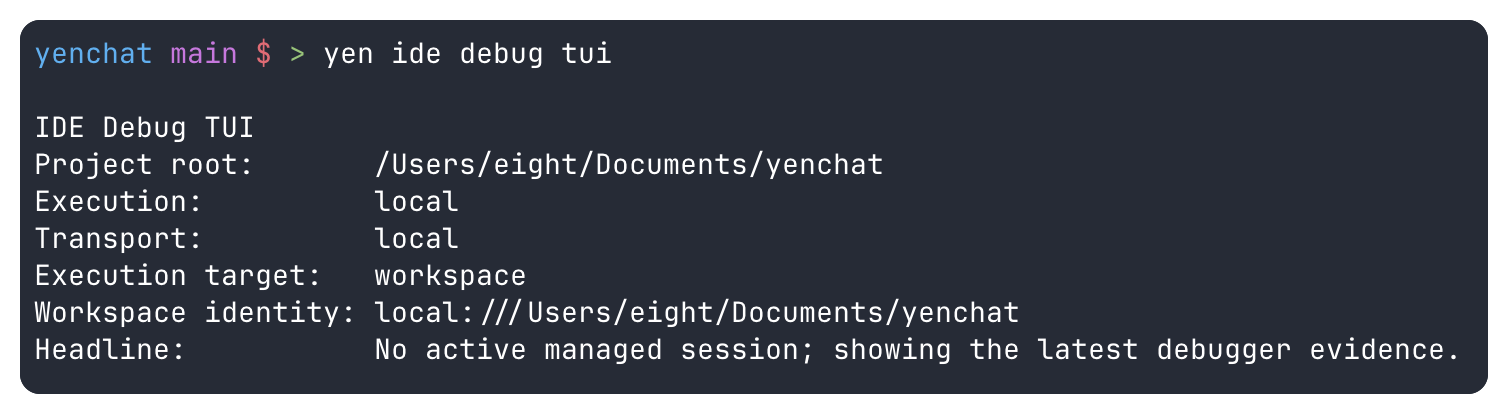
That is also why the visual layer came last. yen ide debug tui now renders the same managed-session state, source excerpt, breakpoints, watches, recent output, and transcript tail instead of inventing a second debugger UI with its own hidden state. When the file is local, the source panel is real. When the workspace is remote, the dashboard says so instead of pretending it can render code it does not actually have. The UI inherits the trust model instead of overriding it.
The same restraint now shows up in the macOS command palette. Empty-query quick IDE actions for Debug Status, Debug TUI, and Format / Lint / Fix Status are just thin launchers over the shipped CLI surfaces. They make the trustworthy path faster to reach without creating a parallel native-only debugger or quality model that would immediately start drifting from the terminal.
That makes the surrounding surfaces sharper too. yen ide test status, yen ide verify status, yen ide search, yen ide merge-readiness, yen ide pr-review, and local diagnostics only append a yen ide debug start ... handoff when the shipped debugger can genuinely launch that target. If it cannot, YEN stays quiet instead of pretending a button is better than an answer.
This is the same trust rule again: Do not promise execution where only suggestion exists. A terminal-first IDE should be willing to leave capability on the table if that is what it takes to keep the chain of evidence intact.
Remote Work Needs One Identity and One Vocabulary
Remote collaboration is where trust models usually split apart.
It is very easy to add SSH-backed behavior to a product by quietly inventing a second control plane. Local work starts using one vocabulary. Remote work starts using another. The same repo gets described differently depending on which side of the network boundary I am standing on. Status gets fuzzy. Trust becomes suggestive instead of explicit.
I did not want that.
So the remote work extended the existing yen ide surfaces instead of branching into a separate remote subsystem. yen ide detect accepts ssh://user@host/abs/path targets. So do yen ide doctor, yen ide trust status, and yen ide verify status.
The point is not that everything suddenly runs remotely. The point is that the same workspace identity now anchors both the local and SSH-backed view of the same repo.
That shared identity matters because it keeps the evidence story coherent. Remote detection reports where execution is actually happening. Trust and verify summaries key their local evidence against that shared workspace identity instead of pretending a remote repo is just another local path. Remote share state does the same thing. yen ide share host, share status, share revoke, share trust, and share untrust now speak the same target shape and the same identity model.
The lifecycle language got stricter too, because vague state is what makes remote tooling feel untrustworthy.
If the host is temporarily unreachable, a session should not suddenly look stale. Disconnected and stale do not mean the same thing. Disconnected means the runtime may still exist and the control plane has temporarily lost contact. Stale means the runtime is gone. YEN now preserves that distinction, keeps reconnect metadata explicit, and lets share status fall back to cached local metadata when the network is the only thing missing.
That is not a flourish. That is the difference between a system that tells the truth under stress and one that collapses into hand-waving the first time SSH gets weird.
Remote Execution Still Has to Admit Its Limits
The last piece of trust is restraint.
Once a remote identity model exists, it becomes very tempting to make every remote surface sound complete the moment SSH works once. That would have made for a cleaner demo. It also would have been dishonest.
So I kept the execution story explicit instead.
Remote workflow discovery is there, and so is real remote execution. yen ide workflow discover, list, show, and run all accept the same remote target shape now. Authored workflows and repo-native tasks can execute remotely over SSH on the same workspace identity, with trust, approval, reports, and timeline ownership staying local.
What is still blocked is the part I cannot defend quite yet: Remote --watch loops and any fake suggestion that the remote machine is under a richer control plane than it really is.
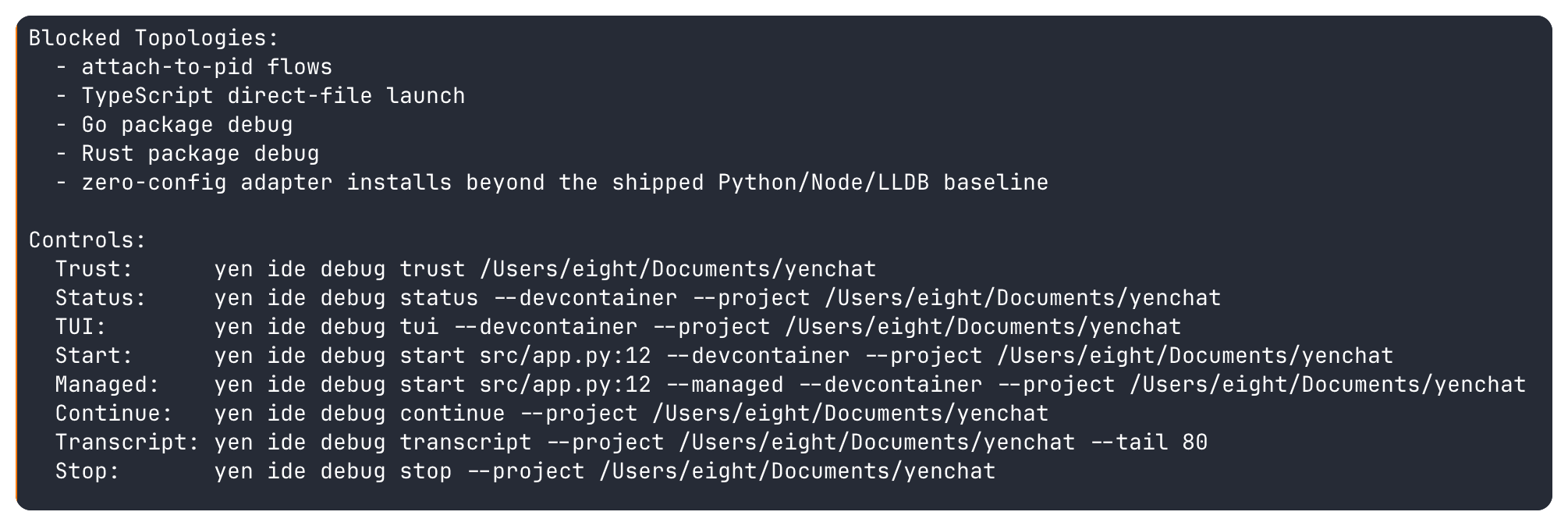
The same rule applies to devcontainers. yen ide devcontainer status, up, shell, and down now work for SSH-backed targets too, and the debugger can reuse that same tracked runtime through yen ide debug status --devcontainer and yen ide debug start --devcontainer when the separate devcontainer trust and health checks are satisfied. If the remote machine is missing the right CLI, the product says so.
If the tracked local state and the probed remote state disagree, the product says so. Labels like spec-drift, disconnected, and missing-remote-cli exist because a terminal-first IDE should not imply a healthy runtime it never actually verified.
That is the restraint I care about now. Ship the remote execution paths that are real. Keep trust and evidence local and explicit. Keep blocked features blocked until the control plane is strong enough that a nicer interface would not just be hiding drift.
This is the part of terminal-first IDE design I care about most now.
The product gets better when it becomes more articulate about boundaries, not less. It gets stronger when the same evidence model is reused in more places, when the same semantic target survives more handoffs, when the same workspace identity survives distance, and when the system is willing to say “I can inspect this, but I cannot honestly claim to control it yet.”
That is what earning trust looks like.
The thesis was that the terminal can be the IDE. The second post was about making that IDE hold together. This phase was about something stricter: Making it legible enough, measurable enough, and self-aware enough that I can trust it when the work gets real. That’s always been the standard.
And now it’s the standard for YEN moving forward. As it should be.
More work to come.
— 8