


Hey folks!
I keep seeing the same AI coding demo pattern: The model writes code, everyone claps, and then someone opens a terminal to find out if any of it actually works.
That moment is the entire thesis.

Chris Dixon wrote in 2011 that in a gold rush, you can mine for gold or sell pickaxes. Investopedia frames the same strategy more formally: Back the suppliers that power the ecosystem, not just the end product. Different phrasing, same lesson.
We are watching that pattern play out again in AI.
The Rush Is New. The Pattern Is Old.
I am not anti-AI apps. Some of them will become huge companies. But hype cycles distort where value is created. The glamorous layer gets attention first.
The infrastructure layer compounds quietly, then ends up unavoidable. In software, infrastructure wins when it does three things:
Gets used every day.
Reduces risk for everyone above it.
Survives platform shifts.
The terminal checks all three, of course. And anyone who’s been writing software for any serious amount of time doesn’t even have to ask these three questions since we live it day in and day out.
The Terminal Already Passed the Longevity Test
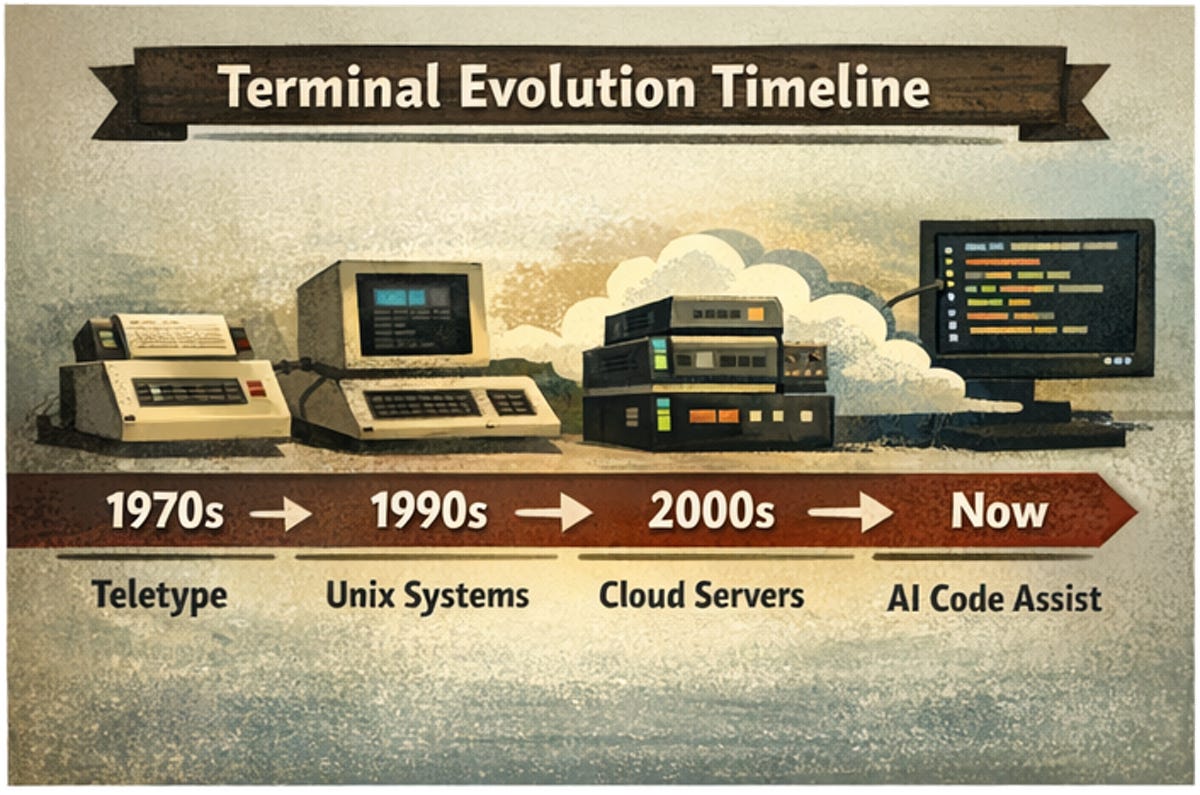
Before AI coding agents, before cloud IDEs, before Electron editors, the terminal was already the operator surface for software.
It survived every era change:
Teletype workflows to video terminals.
Local Unix development to distributed systems.
On-prem servers to cloud fleets.
Hand-written code to AI-assisted code.
The shape of tools changed. The command surface stayed. Why? Because the terminal is where software meets reality. Builds, tests, deploys, migrations, incident response, logs, process control. This is where outcomes are verified, not imagined.
So when people ask whether AI will replace the terminal, I think the better question is: Why would the verification layer disappear when generated output is exploding?
It will not disappear. It becomes more important. It becomes imperative.
The AI Shift Is About Supervision, Not Just Generation
AI changed who types first draft code. It did not change who owns production outcomes. The new workflow is much more supervision-heavy:
Orchestrate multiple tools and agents.
Review large diffs quickly.
Run verification loops repeatedly.
Gate risky commands.
Ship with evidence, not just vibes.
The keywords here are “orchestration” and “observability,” things that all engineers have done manually and in decentralized ways, but now can be done simply, immediately, without context switching.
The payoff is huge: Time savings. And it all comes back to the Terminal as those workloads really belong in a terminal-native environment.
And if your AI tooling cannot make this loop faster and safer and better for everyone impacted, then, you’re still sitting at the demo layer and not the infrastructure one. Time to upgrade your thinking and your tools.
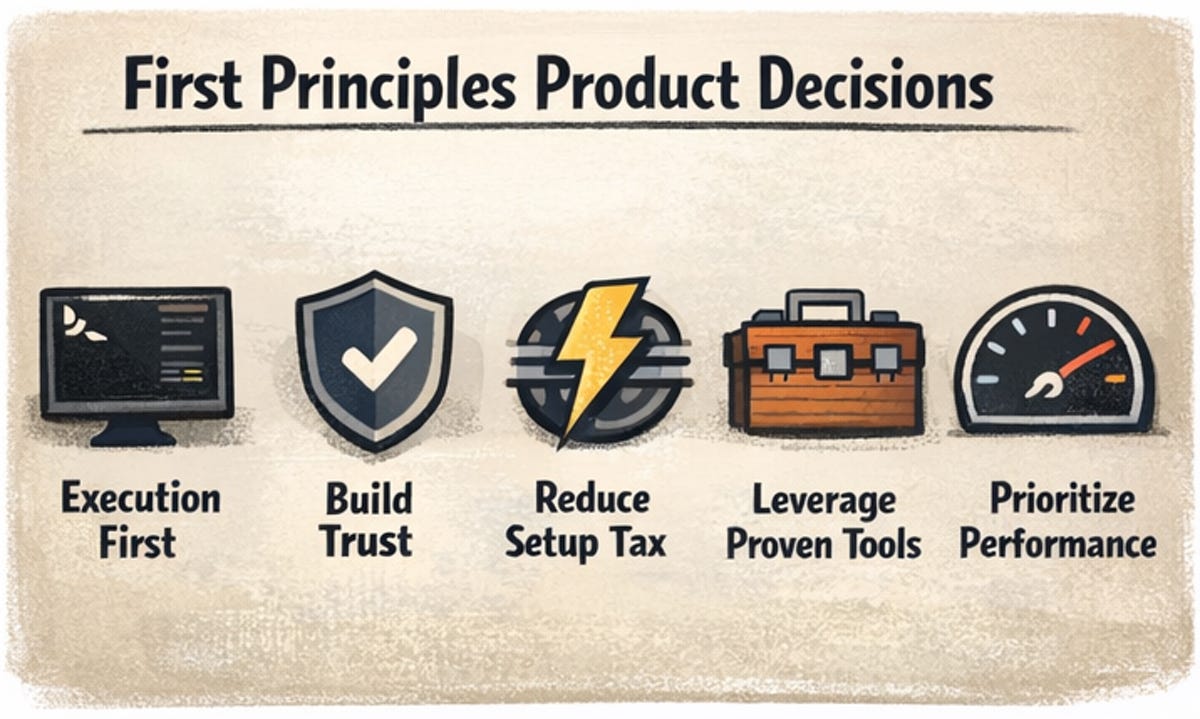
First Principles and Product Design Decisions
YEN is not a trend response. How could it be? It’s a Terminal! Always has been. The fundamental ergonomics haven’t changed but the potential for greater throughput and raw productivity horsepower has never been more real.
In other words, it’s a first-principles product design challenge:
Principle 1: Trust is a product feature and, by extension, privacy and security. This is why it’s a local-first core — no wifi required — and explicit opt-in for cloud-connected workflows. No account or registration gating here! The way it’s always been with Terminals. Boot it up whenever, wherever.
Principle 2: Speed is the trust vector which unlocks maximum leverage and reduces setup taxation that kills momentum. Consequently, bundling modern CLI essentials out of the box makes sense; tools like fd, rg, fzf, zoxide, bat, jq and a file (preview) browser and git workflows. No need to reinvent proven tooling, just like how creators of pickaxes and shovels didn’t have to invent metallurgy for their axe heads and blades for their shovels.
A concrete example: I replaced heavyweight preview dependencies with native helpers and dropped about 258.9 MB of bundled binary weight while keeping the workflow inside the terminal surface. Same user outcome, smaller trust and maintenance surface. Faster. Cheaper. Better.
That is why I describe YEN as a (“THE”?!) terminal-first IDE: A third category between editor-first AI IDEs and cosmetic terminal enhancers.
Why the Solo-Developer Constraint Is an Advantage
This part matters. A lot.
As a solo developer, I cannot win by brute force. I cannot ship ten overlapping systems and hope one sticks. I have to choose an architecture that compounds.
That constraint creates clarity:
Fewer abstractions, tighter control surfaces.
Fewer moving parts, better reliability.
Faster feedback loops from real users.
Stronger bias toward decisions that age well.
In practice, that means building from proven primitives, integrating deeply, and shipping relentlessly. The goal is not to look like a giant team. The goal is to produce a sharper product than giant teams can use without complex dependencies or coordination.
It should just work, as any Terminal should, as expected.
Like riding a bike.
Why YEN Feels Like a Natural Outcome
If you start from first principles, the path is pretty direct:
Developers still execute and verify in terminals.
AI increases orchestration and trust burden.
Terminal infrastructure becomes more strategic, not less.
The right product is a terminal-first IDE.
That is YEN. Not an editor with a terminal panel. Not a terminal with superficial AI garnish. A terminal-native environment designed for modern software work, where AI is part of the workflow but never the trust boundary.
The Bet
I’m not betting on who can produce the flashiest generated code demo this quarter. I’m betting that the teams who ship reliable software in the AI era will depend on better operational tooling at the terminal layer.
That is my pickaxe and shovel position and it’s exactly where I’m taking YEN.
Thanks for your support!
— 8