

Hey folks!
Tiny detour from terminal land today as I just shipped the first real release of a sister product: JPtheCat, a macOS menu-bar app that watches what your coding agents are spending and turns it into something a human can actually glance at.
Yeah, that’s it. Super small utility but something that I cannot possibly live without. You can see me using it while I’m writing this post!
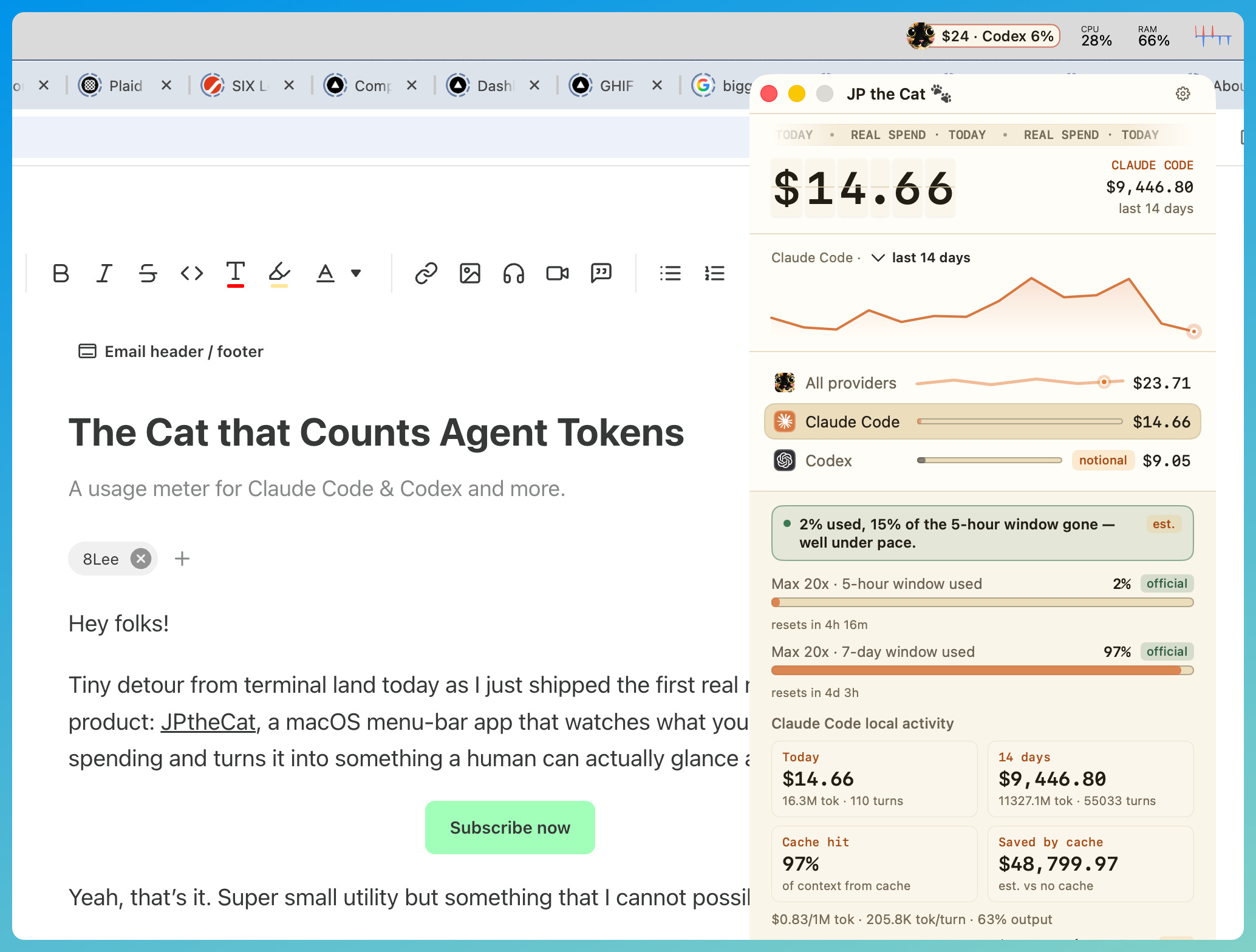
It simple counts your agent tokens so you can keep track of spend. Why? Because token intelligence is literally dollars and cents and if you can master your spend then you end up saving money.
And that’s what I’m trying to do.
The slightly longer version of this is that JPtheCat shows Claude Code spend and Codex rate-limit usage on your Mac, locally, without trying to become a giant dashboard, a cloud billing suite, or another dark panel full of mystery numbers. It is warm, small, opinionated, and yes, it meows.
And it’s the literal sound of my cat, JP. She’s so cute (and spicy).
Why I Built This
Agentic coding has a funny visibility problem.
The work feels magical right up until the bill arrives, or the rate-limit window closes, or a session that felt harmless quietly turns into a surprisingly expensive little adventure. Token counts are useful if you are a machine.
They are less useful if you are a person trying to decide whether to keep going, pause, switch models, or stop asking your agent to rewrite the same function for the seventh time.
Ask me how I know that…
I wanted something that behaved like an instrument, not a report. A small native meter. A menu-bar readout. Something that makes the cost of the current day feel visible without making the whole computer feel like an accounting department.
That is my cat. Or, rather, the digital incarnation of her now.
What JP Does Today
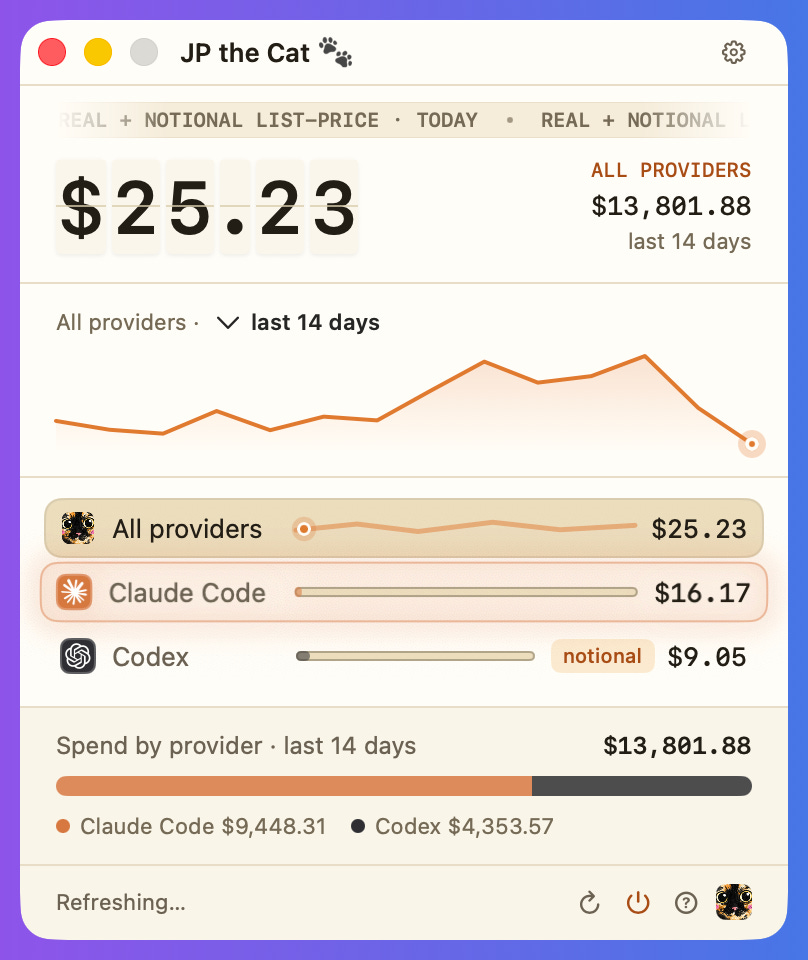
JP the Cat currently tracks Claude Code and Codex.
For Claude Code, it reads the local session data your tool already writes, deduplicates the streamed usage records, handles cache-write pricing correctly, and turns the result into real dollars.
That last part matters. Some usage tools show token counts or rough estimates. JP leads with the number you actually care about: What this is costing you to tokenmaxx to your heart’s content.
For Codex, JP reads local rollout usage and shows the official rate-limit percentages exposed by the tool: The 5-hour window and the weekly window. If a number is official, JP says so. If a future provider needs an estimate, it should be labeled as an estimate.
No provider pretending. No fake confidence.
There is also a 62-provider catalog behind the app, but only Claude Code and Codex are live today. I’m going to work on those after I get the first round of feedback.
The Cat Part Is Not Incidental
JP is not just a logo slapped on top of a spreadsheet.
The app is intentionally light. The website is warm. The menu-bar pill is readable. The dashboard has named light and dark themes. There is a packaged meow. LOL. I had way too fun trying to get a sound capture of her talking.
She is our tiny mascot with very strong opinions about your token burn. Silly, but, not entirely unserious. I mean, money burn is serious stuff.
One thing I keep learning from YEN is that developer tools do not have to feel like punishment. A tool can be local-first, privacy-conscious, technically careful, and still have a little personality.
You see, a terminal can have sounds. A usage meter can have a cat. An installer can be pleasant. These things are not separate from quality. They are part of whether people enjoy using the thing every day.
JP is built from that same instinct. Naturally, cause it’s the same engineer.
v1.0 released yesterday and ships as a notarized macOS app for macOS 14 and newer, with Sparkle updates, a working download endpoint, a 7-day trial, live Stripe checkout, license activation and validation, refund revocation, and a one-time Mac license. The current price is $12.99 for one Mac.
It’s a premium product and one that will only get better with time. No subscriptions. Yay. So much better. You can download the DMG directly from the site, or install it through the public Homebrew tap:
sh
brew tap 8bittts/jpthecat
brew trust 8bittts/jpthecat
brew install --cask jpthecat
There are still plenty of things I want to add: Budget alerts, durable history, export, per-project attribution, more providers, and a deeper paid story after the first release. But the current shape is useful now. It answers the first question cleanly:
What are my coding agents costing me today?
Finally, why post this here? Well, because I can.
But on a more serious note, YEN is about making the terminal feel like a real workbench. JPtheCat is about making the agent layer around that workbench more legible. They are definitely separate products (although integration did come to mind) but fundamentally they come from the same philosophy: Local-first where possible, native where it matters, honest about what is shipped, and allergic to pretending the cloud has to be involved in everything.
Small tools. Clear instruments. Less mystery. More control.
Also, occasionally, a cat.
I’d love for you to give it a try. If you send some feedback I’ll send you a coupon. 100% lifetime key for the first few folks. LMK.
— 8