Focus is a Feature
On removing three whole product surfaces. Dang.
Hey folks!
I just removed three whole product surfaces from YEN:
Chat
Mail
Calendar
This makes me a bit sad but it was as important of an update as many others in the last few months. Focus is a feature and it’s hard to do.
This is, of course, not the usual kind of release story. Most product writing is about what got added. This one is about what I decided not to keep carrying.
I think that matters, because one of the easiest ways to make a product worse is to confuse activity with progress. Shipping more things is easy to celebrate. Carrying more things forever is the part that gets expensive.
And it’s really easy to add features these days which means that the most important decisions is what you decide to not build and ship.
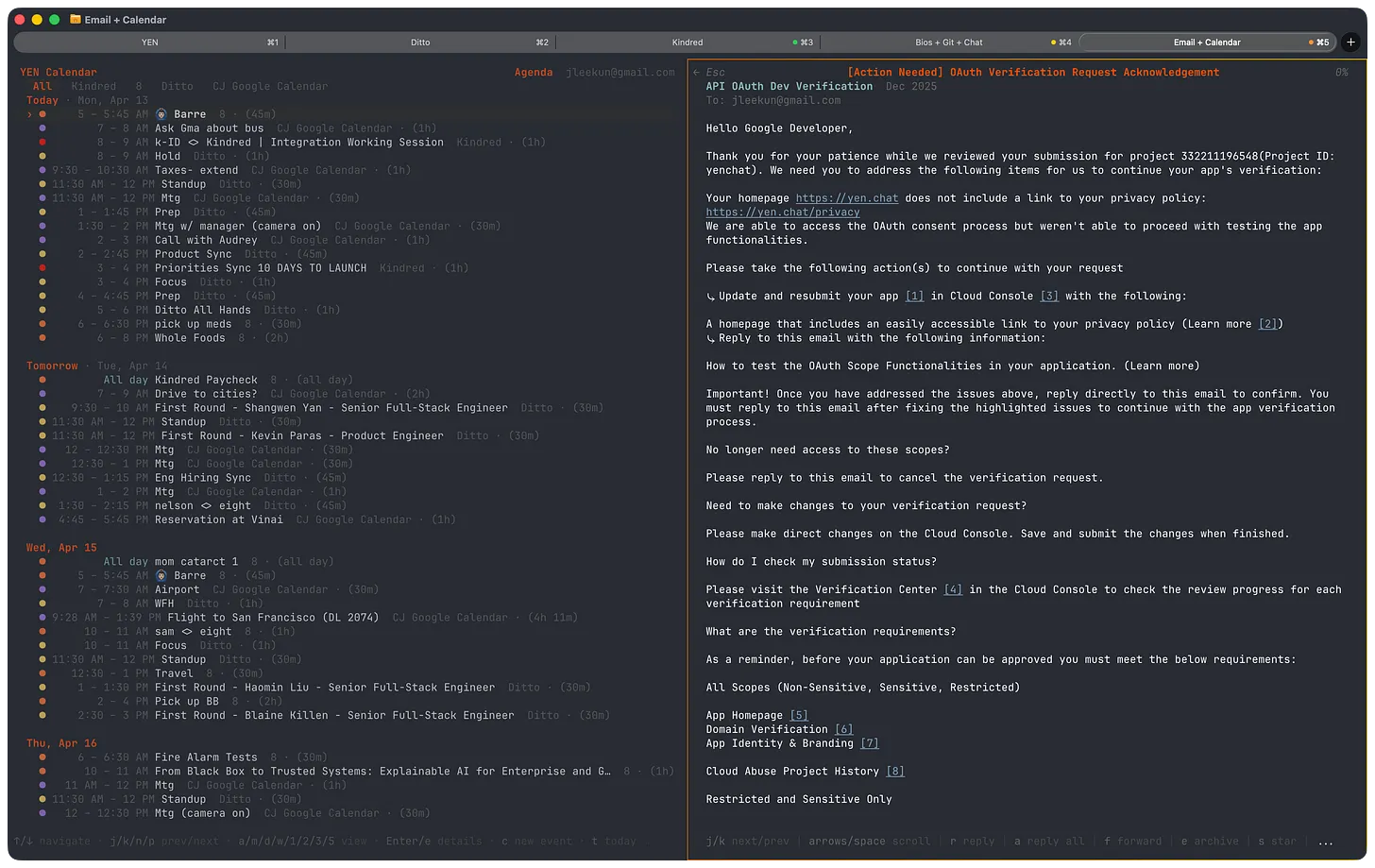
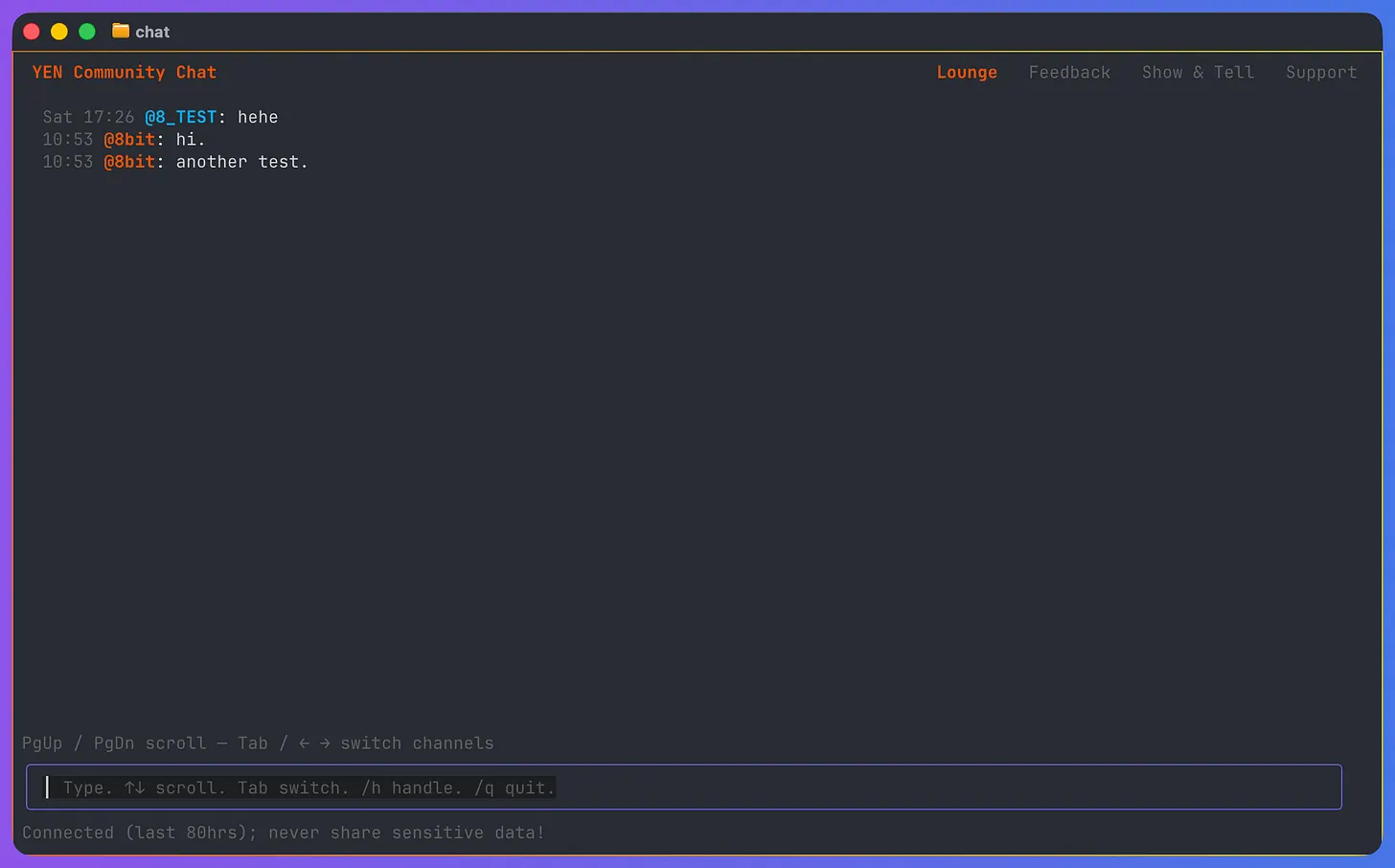
You see, for a while, YEN had a broader shape. It was not just a terminal-first IDE. It also had a community chat surface, a mail client, and a calendar client living inside the same product. At one level, that was interesting. It proved that the terminal could hold more of a working environment than people usually assume.
But there is a point where an interesting proof stops being the right product.
The point is that I do not want YEN to become one more app that keeps every experiment alive because removing it would feel like admitting something. I would rather be honest about what is actually central.
The central thing is the terminal-first IDE.
That means:
Native terminal quality
Trustworthy local workflows
File and project navigation
Build and review tooling
Command surfaces that make terminal work faster without making it feel fake
Chat, mail, and calendar were not strengthening that center anymore. They were competing with it. And, to be honest, not many folks were using them but that’s also because we’re still pretty small (and growing).
The deeper problem is surface area. A product feature is not just a button or a command. It is an ongoing obligation. Chat meant backend tables, storage rules, attachment handling, proxy paths, privacy assumptions, moderation-adjacent questions, cleanup rules, and public documentation that had to stay true.
Mail and calendar meant OAuth flows, keychain assumptions, callback routes, local state contracts, desktop integration residue, notification semantics, legal/privacy copy, and recovery behavior for systems YEN did not control.
Even when those features are “done,” they are not done. They keep charging rent:
Engineering attention
Test coverage
Release anxiety
Documentation maintenance
Privacy and legal review
Restore-path complexity during unrelated refactors
That is the part people underestimate and certainly not something that anyone non-technical would even think about (although those folks are probably not using YEN).
A small feature that touches auth, network boundaries, notifications, storage, and public docs is not small. It is a permanent tax. No one likes taxes. Taxes suck.
But the the non-obvious gain is trust.
I think product focus is often described too softly, like it is mostly an aesthetic preference. It is not. Focus improves trust. Every feature I remove is one less thing that can silently drift out of sync. One less thing that can break on release day. One less public claim that can become false. One less background system whose edge cases I have to remember when I am changing something that should have been unrelated.
That matters a lot for a terminal-first IDE, because this kind of product only works if people believe the boundaries are legible.
Subtraction is part of honesty. YEN does not get stronger by collecting adjacent ideas forever. It gets stronger by becoming more exact about what it is for.
The best version of YEN is not “the app that also does everything else.” It is the app where the terminal is the center of gravity, the desktop integration feels native, the workflows are trustworthy, and the extra surface area earns its place.
Chat, mail, and calendar stopped earning their place. So I removed them. I think more products should do that.
There is a lot of pressure in software to act like every shipped feature is sacred. I do not buy that. Sometimes the highest-leverage feature is the one you stop shipping. Sometimes the most user-respecting thing you can do is narrow the promise. Sometimes focus is not what remains after product strategy.
Focus is the product strategy. That is what this cleanup was really about.
YEN is better when it is more itself, as it has been and as it should be. Authenticity. Truthfulness. Clarity. Focus. The result? Even greater productivity.
That’s the point.
— 8